
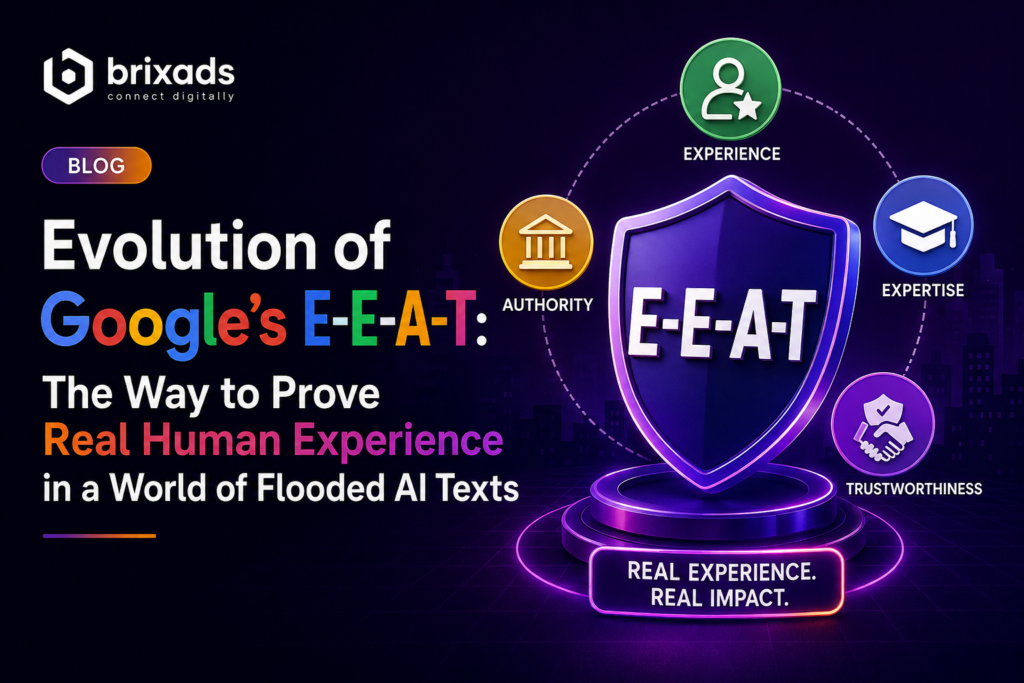
Evolution of Google’s E-E-A-T: The Way to Prove Real Human Experience in a World of Flooded AI Texts

The internet is evolving very quickly. With the use of AI, people can create articles, product descriptions, social media posts, guides, and other forms of content in a matter of seconds. However, if all people can write texts, then real experience will become even more valuable. Here comes the role of the E-E-A-T concept by Google: Experience, Expertise, Authority, and Trustworthiness. It should be noted that Google claims that E-E-A-T itself is not a ranking signal.

What do E-E-A-T mean?

The trust aspect is the most important factor for Google, and the other factors are its elements.

Why First-Hand Experience is More Important

AI may summarize several hundred existing papers but it cannot replace practical experience.

Imagine two papers devoted to Google Ads.

The first paper describes basic notions of advertising taken from commonly available sources.

The second one describes how the campaign was planned, who the target audience was and what issues related to the landing page were identified, fixed, and learned from.

The second one offers much more than the first one – first-hand experience.

Google currently advises focusing on first-hand experience.

How To Prove Businesses Have True Experience

Just telling that you get things done is not enough. Describe what problem you solved, what strategy, implementation, difficulties, and lessons you have from true projects.

Instead of copying some examples from somewhere else, create your own based on your industry experience.

Make it evident who created this content. Google suggests using accurate bylines where one would expect them and providing information about the author in case of relevance.

Screenshots, photos, diagrams, campaign examples, graphs, and videos can prove that true work was made before the creation of this content.

People more and more often want to know how something was created. When artificial intelligence helped you in this process, describe it.

AI Is Not Necessarily the Problem

Using AI does not necessarily render the content unacceptable to Google.

According to Google, AI can be valuable in creating helpful content; however, using AI mostly to game the search ranking system is against its spam policies.

The question becomes whether the content provides any value in itself.

AI can assist in conducting research, organizing the structure, brainstorming ideas, and editing. The human knowledge needs to contribute to experience and judgment.

Content Strategy to Follow in 2026

From:

AI-produced content → Publish → Hope for SEO

To:

Experience → Insight → Content → Evidence → Human verification → Publish

The above strategy will produce content that is difficult to duplicate and more helpful to customers.

An example of how this can be done would be when a digital marketing agency creates a case study out of an experience, then converts those insights into a blog post, social media post, video, FAQ and guide.

Content Strategy to Follow in 2026

With the web being rife with AI-written articles, the mere act of creating additional content is not what gives one an edge.

It’s experience.

Tell people what you’ve accomplished. Tell them what you learned from those experiences. Show them evidence. Tell them who created that content.

The recommendations provided by Google continue to revolve around helpful, unique, human-oriented content rather than content created in pursuit of search traffic.

If you are a business looking for ways to develop a strong SEO and online presence, Brix Ads works on developing digital marketing strategies using content marketing, SEO, paid media, social media, and audience analysis.

Brix Ads

📞 9744400414
🌐 brixads.com
📧 brixadsofficial@gmail.com